Disclosure:

As an Amazon Associate, I earn a commission on qualifying purchases within this blog.
Showing posts with label Mary. Show all posts

Wednesday, March 28, 2018

A bagel, a nose and a disturbing thought for Christians


On our way to the Upper Room which is in a large, unassuming building for Jerusalem, we pass a statue of King David and notice its broken nose. Some Orthodox Jews took offense to someone making an image that could be worshiped. The men responsible are satisfied with the damage, for until it is complete again, it’s no longer a graven image. 


Can you see David's broken nose?

Jews consider David, whose name means The Lover or Beloved, to be perfect, but even he admitted he was a sinner. Yet, he knew how to ask for forgiveness when he sinned.

We learn that there are three levels to this building, the lowest one being the Tomb of David, although our guide says David is buried with his father in the Kidron Valley. Nonetheless, it’s sacred to the Jews and when we walk in, we’re segregated according to our sex and because it's the Sabbath, the electrically lit menorah is covered in black fabric. A young Jewish woman at our side tells us no photographs, for it’s forbidden to work on the Sabbath. She is here praying, as I look around. Above me is a plastered ceiling and in front of me was a small Wailing Wall set behind a menorah, separated from the men by a wooden panel. I apologize to the woman for disturbing her prayers. She smiles warmly and touches my arm, saying it’s all right.

The second floor is the Upper Room, repaired during the crusades. It has a medieval flavour, but only one column remaining from Jesus’ time. 


The only column from Jesus' time.

Our guide read from the Bible on Holy Communion, and then tells us that first Communion happened 6th April 30 AD. So exact. 


We leave, but don’t go up to the third floor. It’s a minaret as the Muslims once held this building. Instead, we walk to the Church of the Domition, where Mary is said to be buried. Of course, Ephesus makes that claim as well. This church says ‘where Mary fell asleep’. Being a bit slow, I had to ask what that meant. 

 
A view from behind the Upper Room

It’s interesting to note she was supposed to have been 127 years old, and those numbers signify 1- age, 2- beauty 7- purity. It was also Sarah’s age when she died. Numbers apparently have significance in the Bible.

Inside, someone is playing Bach’s Trio Sonata allegro on the organ and it sounds to me like the Christmas music played at the Mount Allison Chapel in Sackville, New Brunswick. 

This is the building that has both David Tomb and the Upper Room


After we leave, our guide leads us to a shady spot. Some of group have found the walking hard as it’s up and down on irregular steps and it was warm in the Upper Room. I notice our guide has applied sunscreen, but the sun feels nice to me and I don’t burn. There in the shade, Yossi tells us that some people are deeply concerned that the Trinity will become the Holy Quartet. That is, the Father, Son and Holy Spirit will soon include the Virgin Mary because so many worship Mary some calling her a goddess, some going so far as to say she rose from the dead like Jesus. It's a disturbing thought.


We pass the bagel stands we'd seen earlier, and I buy a Jerusalem bagel, asking for the za’atar, the small pouch of herbs that goes with it. The cost – 10 NIS. 

Long bagels with herb pouches are Jerusalem Bagels
This stand also sold sweet treats and dried fruit.

We head back to the Grand Hotel, where in the courtyard, my husband and I  share the bagel with our friends. It’s big enough and the courtyard pleasant enough until we head to a distinctly American establishment. 

Friday, March 23, 2018

Deep under the Old City


Today's post is long, but packed with interesting facts.
It’s Friday, and we enter through the Damascus Gate, then walk through the Muslim Quarter. It’s the day for sweets and desserts, but Yossi warns us that they may not be safe for us to eat. People here eat very sweet desserts so they can tolerate the hot spices after the taste buds have been numbed by the sugar. But isn't dessert eaten last? I kind of like the idea of eating it first.

Super sweet treats to numb the taste buds

We stop at one of the signs that say, ‘Via Dolorosa’, the sacred street. There stands a group of police, which includes the requisite female officer.

Part of the Via Dolorosa, the Way of Sorrows


The female officer had stepped out of the photo.

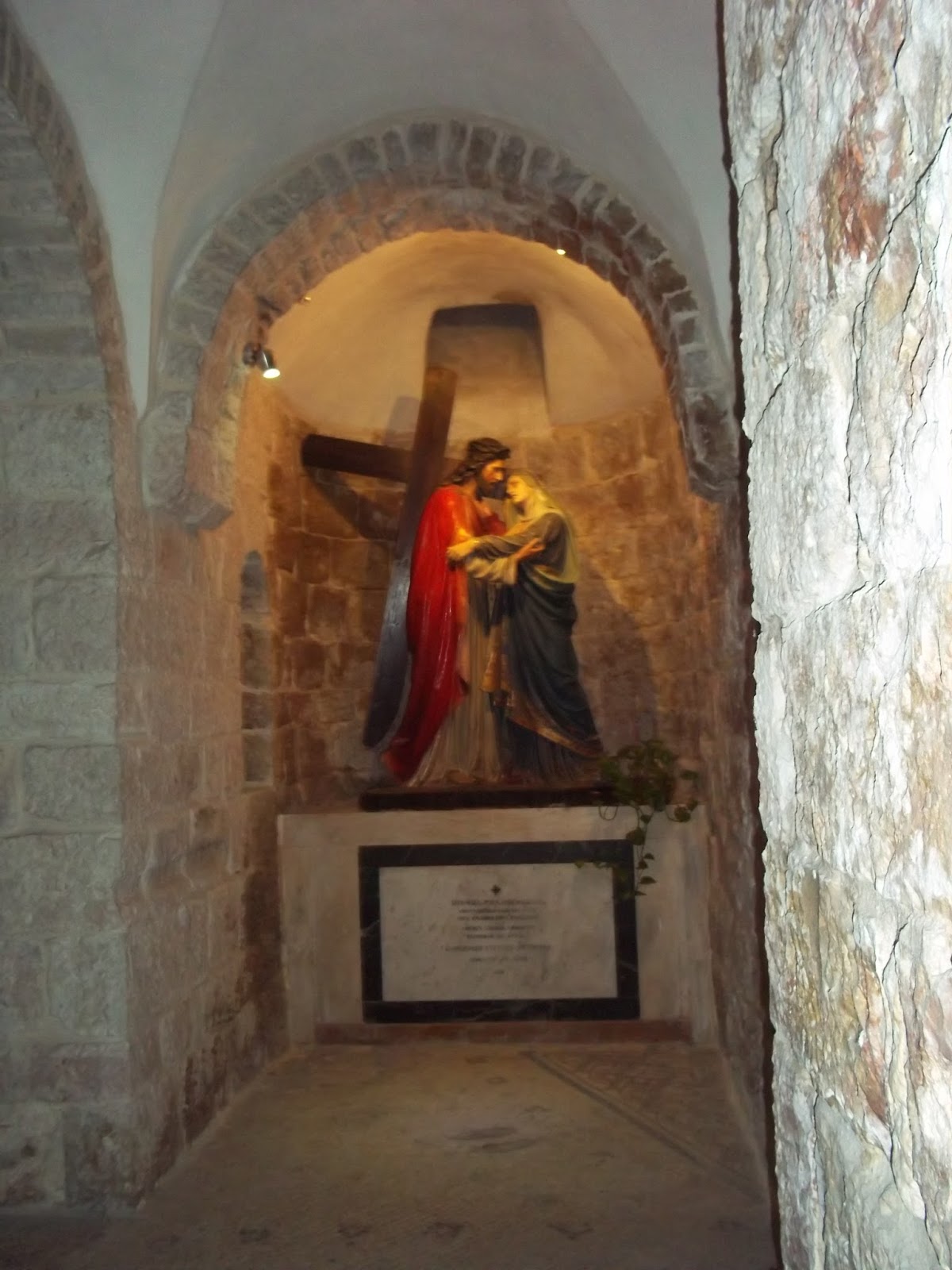
Yossi takes us to the fourth and fifth stations of the cross, where he met his mother and where Simon the Cyrene took up Jesus's cross, and deep beneath that Monastery is an original floor from the Byzantium period. 
 
Like many places here, silence is demanded.

Looking at the depiction of Jesus meeting his mother.


Explaining the mosaic floor.
  
This tour feels so fast to me now. I barely remember going from one station to the next, but in our guide's defense, there is much to see.


Entering the Monastery


Soon we enter the tunnels under the city. We learn that Herod the Great considered himself a god, and that the Temple Mount today is only a small portion of its original size. Yossi stops us at a large stone, and at 586 tons, made in 12 BC, it is considered to be the world’s largest man made block. We discover that many Muslims ask the rhetorical question, ‘If the Jews were given the Temple, why did God allow them to get kicked out of the Holy Land and the Temple to be destroyed?’ It seems strange for me to hear that question. If only people would read the Bible. The answer is simple. God doesn't want things. He wants our hearts.

Part of the world's largest cut stone.


We pass a small prayer room for men, and our guide opens the door to peek inside. Naturally, it is shut immediately, leaving our guide to admonish us. “Shame on you, ladies.” He goes on to tells us that part of the traditional men’s prayer says, “Thank you for not making me a woman.”


No peeking!


Still deep along the tunnels, pathways only a few feet wide and in spots barely six feet high, we stop again at the women’s section, the closest place the Jews can get to the Holy of Holies. It seems odd to me that women are allowed so close. We pass a woman who yells at us that only Jews are supposed to be here. 

Going deeper under the city

I can see small prayer requests tucked into cracks in the wall, just like outside at the Western Wall. Our guide reiterates that the Temple Mount is not sitting on stone, but a powder keg, and again, says that Israel needs our prayers. 
We look down a shaft whose length is about ten feet, but only inches wide, and yet, 30 to 50 feet deep. We can see the original stones, and learn that archeologists need the rabbis’ permission to dig and as a result, parts of the old wall are surrounded by cement to prevent defiling. After all, our guide reminds us, archeology is a destructive trade. 

Later that day, we visit the Shrine of the Book, a museum that houses parts of the Dead Sea Scrolls. The one on display is a clever reproduction, though, as the original is in a vault somewhere else. The Russian Mafia wanted it destroyed. A young man kindly translates some of the verses for me, explaining what a pseudepigrapha is. (So you don’t have to look it up, it’s a collection of Jewish proverb-like books) 
Our guide tells us that the Dead Sea Scrolls that feature Biblical texts are 99% identical to our present-day versions. We also discover that the margins of the Talmud (a group of writings that expand on Jewish teachings) mention Jesus, calling him the son of Satan, saying how he called on the forces of darkness. We can read this as proof of Jesus’ existence, since his enemies admitted he walked this earth and did miracles. How can people say he didn't exist when there is extra-biblical evidence of him?
 
Scale model of Jerusalem


Can you see the temple in this model.


We head out to the scale model of Jerusalem during Jesus’ time on earth, and I wonder why Israel chose to recreate that time period. It’s a huge, fascinating model, and we see how Golgotha (where Christ died) is outside the walls, and how King Herod’s palace is under the Armenian Quarter. It's unavailable to be excavated because the Armenians say that the Jews don’t recognize the Armenian genocide by the Ottoman Turks over a century ago. Even now, politics feature heavily in the search into our past.

We hear about Jesus here, how much he loved those who were crippled, in contrast to armies of the past that sent cripples and bodies ahead of itself to act as a human shields. I wonder if this comes from 2 Samuel 5:8, where ‘the lame and the deaf will hold you off’. 
Next, we are going to see the very highlight of this museum. 

To me, it's the Mona Lisa of this world.

It's like Jello

Again, it's been ages since I wrote a blog, and I am sure my followers have forgotten all about me.  But when life takes you on a trip, ...